

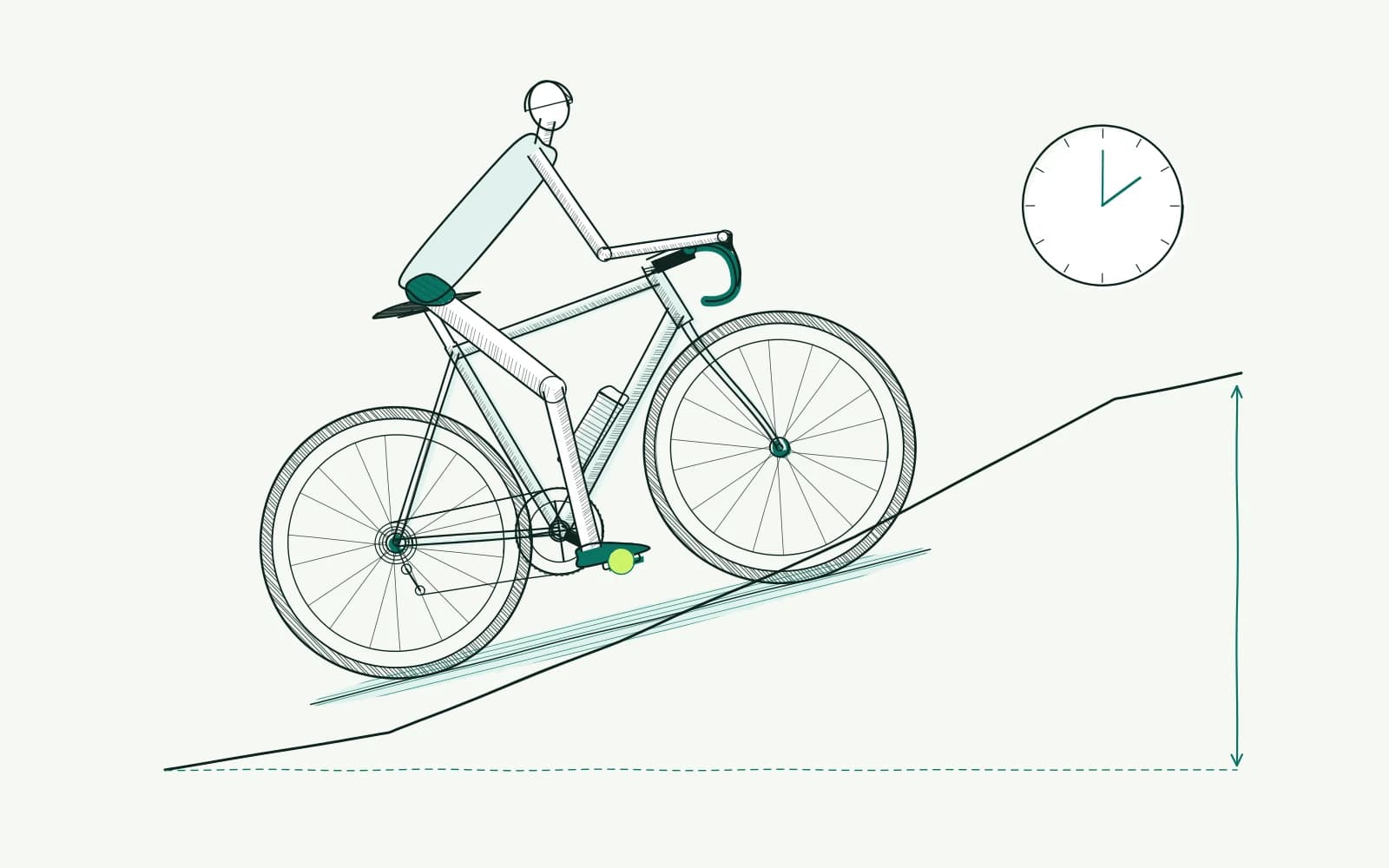
The problem: estimating cycling climb time
You are planning a hilly ride and want to know when you will reach the top. The distance looks manageable, but the elevation profile leaves you unsure. Perhaps you still have further to ride afterwards. A fast first climb is not automatically a good start.
On previous rides, you may have started too hard. A steeper section forced you to push a heavy gear or stand. Your expected arrival time kept slipping. A calculation can then create pressure instead of clarity.
Comparing yourself with a riding partner does not always help. Your mass, bikes, positions and available power differ. An average gradient also cannot describe every change along the climb. A steady road differs from alternating steep and flat sections.
This guide helps you interpret an estimate and check it practically. You do not need a record attempt. The aim is a workable starting point, allowing for traffic, conditions and personal experience.
Background: what the calculation includes
The climb calculator uses distance and average gradient. You also enter body mass, bike type and FTP. Here, FTP provides a power reference, not proof that you can sustain it everywhere. The calculation selects a power factor using a distance category.
That is a simplification. A short, steep climb can take longer than a longer, shallow climb. The distance category therefore measures neither your capacity nor the actual duration directly. Do not treat the suggested power as an instruction.
The physics model adds resistance from climbing, rolling and air. It also accounts for drivetrain losses. Body mass and a default bike mass together form the total mass. The chosen bike type also supplies fixed assumptions about aerodynamic resistance and surface.
There is no personal measurement of your position. Wind is not entered separately. A headwind can change your actual speed without the calculator knowing. Luggage, road conditions and stops may also differ from the assumptions.
Calculated time comes from distance divided by estimated speed. This assumes a steady situation. It does not predict braking, corners or transitions between sitting and standing. A reliable time is unavailable outside the calculation range.
A suitable position helps you control the bike and assess your effort. It does not guarantee a time saving. Online tools let you compare inputs, but cannot establish your personal limit for sustained exercise. Keep the calculation alongside your ride notes, rather than giving it priority over them.
How to approach it: from estimate to practice ride
-
Check the route profile: Record the climb length and the source of its average gradient. Look for the steeper sections too. Keep distance in kilometres and gradient in percent to avoid mixing units.
Plan a safe route back and allow for breaks. An arrival time must never decide whether you continue in unsafe conditions.
-
Record your inputs: Use current body mass and a recent FTP estimate with a known origin. Record how that value was obtained. Choose the closest bike type and remember that its mass is a default value.
Use the climb calculator to record your starting point. Consider carried luggage when assessing uncertainty in the result.
-
Compare assumptions: First change only FTP to another value supported by your own records. Check the effect on time and power. Then consider changing gradient if your route information supports a different value.
Do not select a favourable number to obtain a desired finish time. This comparison shows sensitivity to assumptions, not an individual training prescription.
-
Check your reach while climbing: Record which hand position you use on the climb. On a quiet, safe section, check whether you can shift and brake from that position. You need to look ahead without letting go of the controls.
If a brake lever is difficult to reach, check whether your model offers reach adjustment. Have it adjusted according to manufacturer instructions if needed, then check braking operation. Record the original setting; keep handlebar components within their clamping marks and respect specified torque values.
-
Ride two to three easy trials: Use a familiar climb and change only one element at a time. Keep route and conditions as comparable as possible. Afterwards, record position, selected gear, perceived effort and any discomfort.
Only then compare actual time with the estimate. Restore your previous setup if control or comfort worsens. Do not make the next ride harder simply to achieve the calculated power.
-
Allow flexibility and recognise warnings: Avoid connections that depend on achieving the predicted time. Stop for pain or unsafe handling. Ask a fitter to review a persistent position problem.
Pain at rest or at night, swelling and radiating tingling need medical assessment. If pain remains after three to four careful adjustments, seek help instead of continuing to experiment.
Further reading
- What is cycling FTP? helps you assess which power value to enter and understand the uncertainty attached to it.
- Cycling power and speed: what changes? explains why the same effort can produce different speeds along your route.
- Mountain bike fit: control and movement helps you check position and control when your climb includes unpaved sections.
- Endurance bike fit: comfort over distance helps you consider the distance still remaining after the summit.
- The climb calculator makes assumptions visible so you can compare different route inputs deliberately.
Frequently asked questions
Does the displayed time include my breaks?
No, the model calculates time from distance and estimated riding speed. Add room for stops yourself when planning. Allow for junctions and waiting too. A precise number on the screen does not mean your arrival is predictable to the nearest minute.
Why does average gradient not match every section?
An average summarises the whole climb. It can hide steep ramps and flatter sections. Look at the route profile alongside the input field. Your gearing needs to suit the sections you actually ride, rather than just the average shown in the calculator.
Should I maintain the suggested power throughout?
No. The power factor is a model choice based on distance. It is not an individual exercise test.
Use experience and conditions to ride more gently whenever needed. Choosing a lower effort does not mean you have failed to follow the calculation correctly.
Does a different saddle height predict a time saving?
No, the calculator does not measure saddle height or predict its effects. Adjust only for a clear position or control question. Record the starting position and test carefully. Judge comfort and control rather than expecting a promised improvement on the clock.
This guide covers one part of your riding position. Read how bike fitting connects your measurements and bike setup.
Estimate your climb time using your own inputs and use the result to prepare for a measured ride.
Estimate your climb time